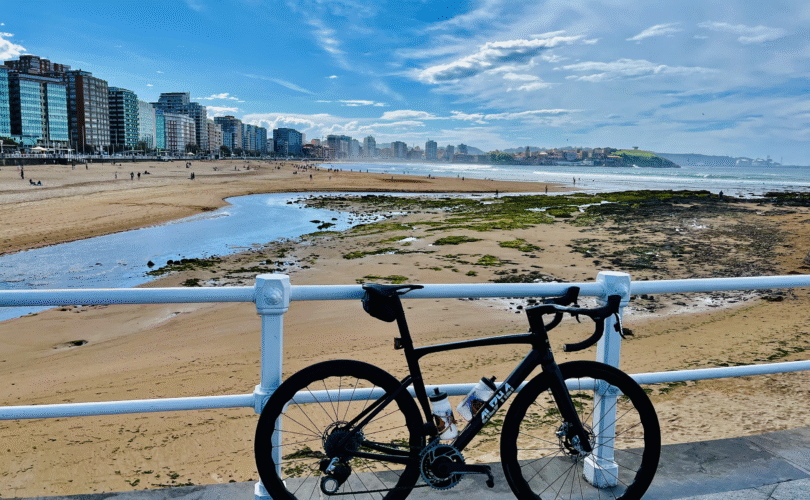
When researching your road cycling holiday destination in Spain there are many factors to think about in finding ‘YOUR’ ideal destination. Location, location, location is key to finding a road cycling destination that is suitable to your abilities but also the overall enjoyment of your cycling holiday.
Road Type
Being based on the coast may seem ideal but look at the network of roads on offer for you to ride on.
Generally coastal roads are very busy with traffic both locals going about their daily business but also tourists who maybe struggling with the concept of driving on the ‘WRONG’ side of the road. These roads are usually dual carriage ways with fast moving traffic or ‘Toll’ roads where bikes are not allowed. Toll roads are defined on Spanish maps as AP (+number), AP means Auto Pista. Whilst studying Spanish Maps please note that N (+number) and A (+number) denote National routes these roads generally have faster moving traffic too.
Ideally you want to be riding on Provincial roads these are defined by 2 letters and usually 4 numbers eg MA8403. The 2 letter relate to the Province CA = Cadiz, SE = Sevilla & MA = Malaga and so on.
Location
Another important factor to look at is the road network at your chosen location. Will you be spending the first and last 20km each day riding the same road in order for you to access the nicer areas for riding.
Adding 40km to your ride everyday just so you can find some quieter more scenic roads adds a lot of unnecessary riding to your days/week, after all if you want to see the best of your location you really want to be based in the middle of the ride action. Also note the altitude of your road cycling holiday location and the surrounding area, for example if you chose a village at 1000m above sea level and all the roads are generally lower than this level then there may be a BIG climb at the end of each day to get back to your accommodation
Riding Safely
When riding on the roads you will see that most main roads, N or A roads, will have 3 white lines. 1 in the middle (dotted or solid) and one on the right hand side of your lane and one on the right hand side of the opposite lane (these are solid) and then there is usually another half metre of tarmac forming a hard shoulder. Please ride in between the two lines defining your lane for the following reasons
- If you ride on the Hard Shoulder, this part of the road will vary in width causing you to have to weave on and off your defined lane which is more dangerous than riding a steady line within your defined lane
- The Hard Shoulder will also have a substantial amount or road debris and therefore the chance of a skid or puncture is higher
- More importantly, if you ride on the Hard Shoulder you are officially off the road and the cars/buses/trucks DO NOT have to move out of the lane to pass you
Spanish Highway Code
The High Way Code in Spain states there should be a white line between you and the vehicle passing you, so if you ride in between the 2 white lines which define your lane most vehicles will straddle the white line in the middle of the road when passing you and you have bought yourself 1.5m of space.
The Highway Code also states that if there is an accident between a vehicle and a cyclist it is automatically assumed to be the vehicle drivers fault. For this reason most Spanish drivers will wait behind you on quieter country roads until they are confident that they can pass you without causing you a problem and they will do this for a few minutes too. Hard to believe I know!! If you do not like this pull over, make them go around you and then carry on riding. Please acknowledge their patience when they pass you by giving them the thumbs up. Occasionally you will get cut up but you can bet the car will have a car hire sticker on it from one of the airports!!
Other points to note when riding in Spain
- It is the law to wear a cycling helmet. The Guardia Civil can fine you 200 Euros for not wearing a helmet
- You can ride 2 abreast on the road but not 3 abreast. The Guardia Civil can fine you for riding 3 abreast. Discretionary amount depending on how bad a day they are having!
- Obey the Highway Code at all times.
- Do not drink (alcohol) and ride.
- Remember to ride on the right hand side of the road.
Montecorto
Here in Montecorto we have an excellent choice of routes straight out of the village. Montecorto is at 450m above sea level, we have some climbing to do at the start of most days but this does mean we usually descend into the village at the end of the day. Montecorto is perfectly located for a fantastic week of road cycling. We mainly ride the Provincial roads and traffic is minimal. We can frequently ride for 10-15 minutes without seeing a vehicle on the roads.